When I was nine years old, I became a huge Star Trek fan for several years. More precisely, the Next Generation’s NCC-1701-D, with its sleek silhouette, glossy touch screens and pastel interiors, captured me entirely. It also catered to my developing compulsive orderliness — there was no dirt, no clutter and everyone was equipped with a distinctive yet uniform taste. It gave me incredible mental comfort and a radically optimistic vision of the future.
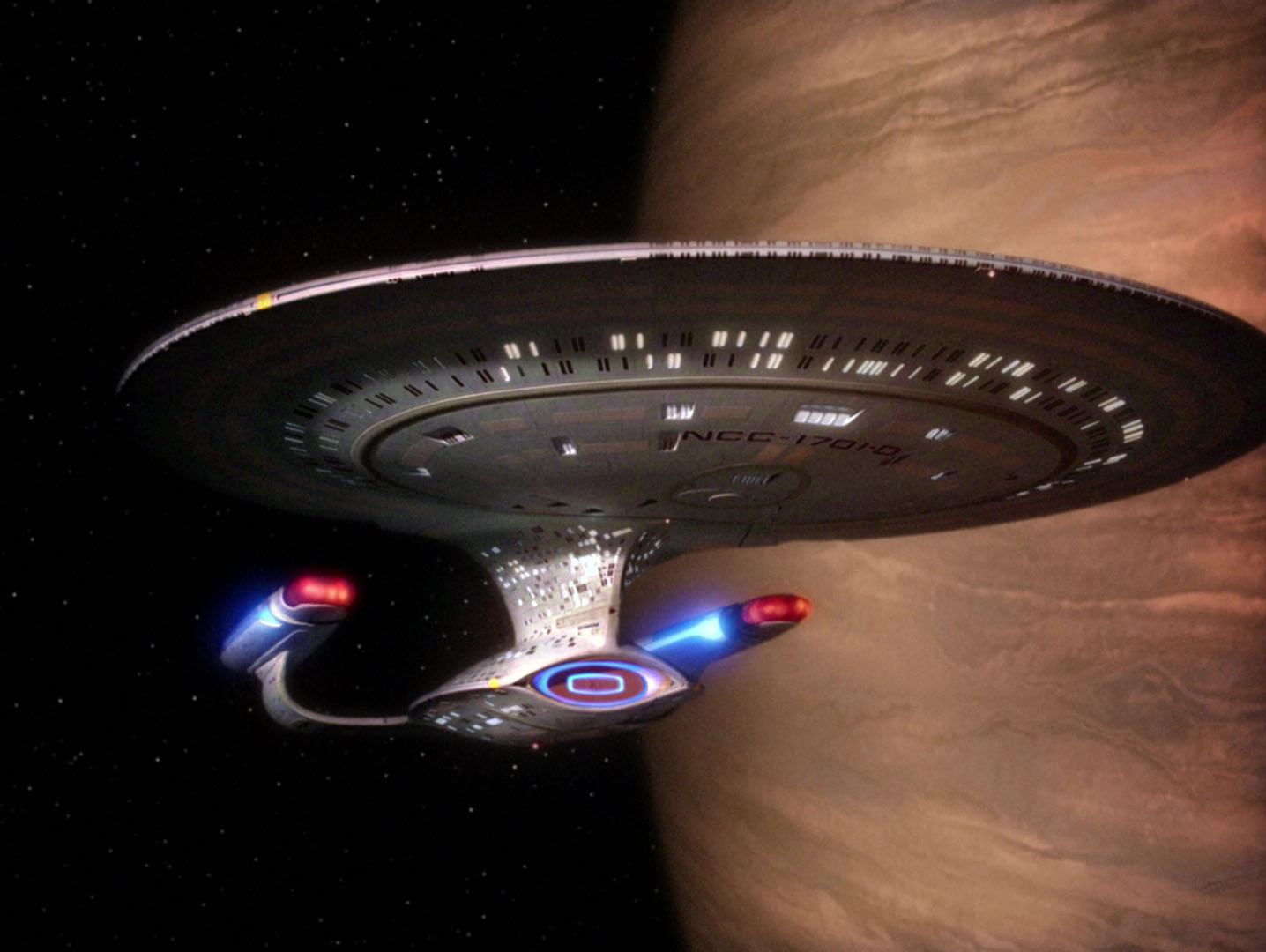
As a kid I was obsessed with this space ship. I spent hours studying the blueprints and imagining myself walking its endless beige hallways. (© CBS Studios Inc. / Paramount Pictures, still image from Trek Core)
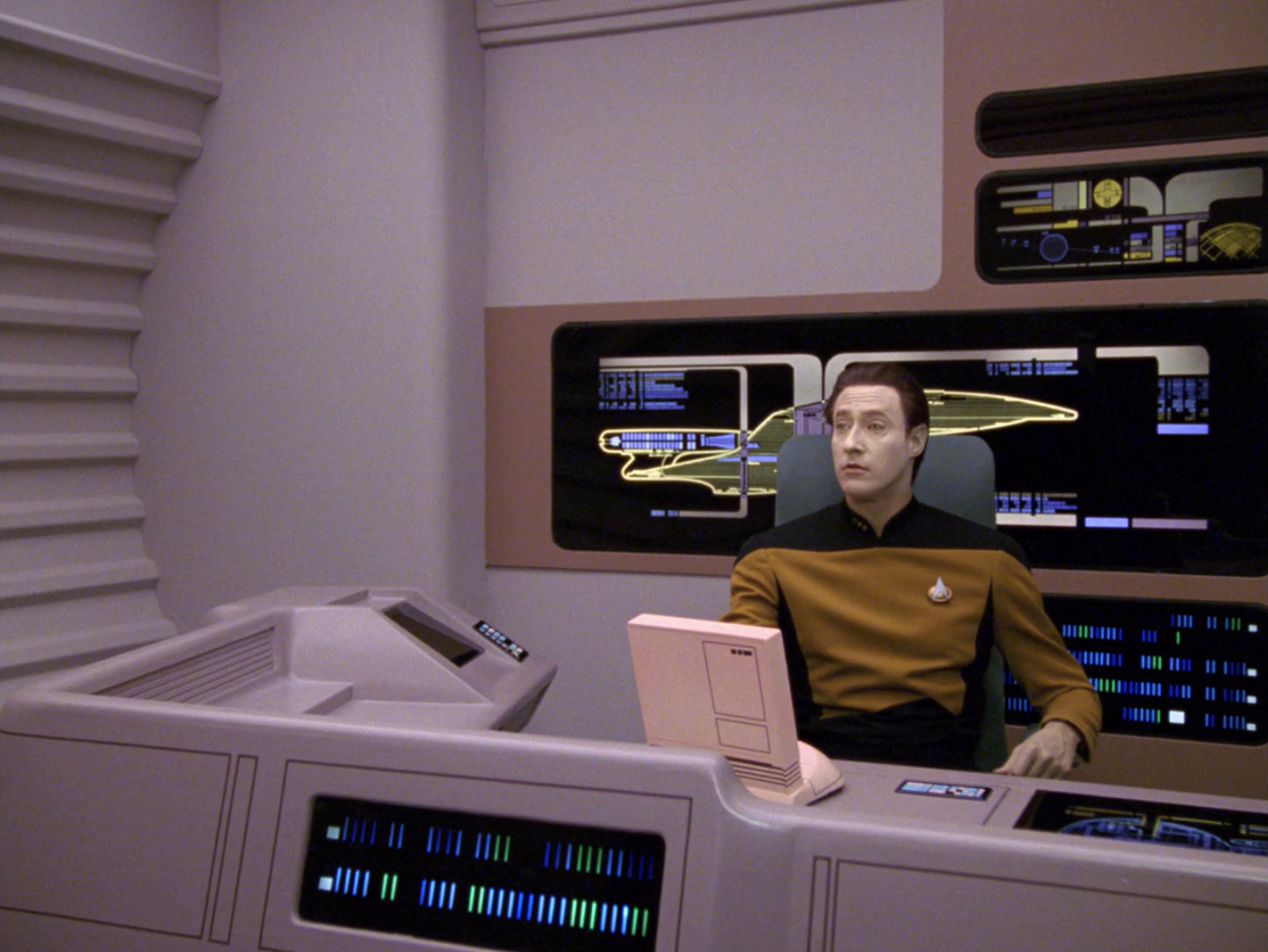
My favorite character, working from home. I am still marveling at the production design. (© CBS Studios Inc. / Paramount Pictures, still image from Trek Core)
There is no money in this world (mostly), and no shortage of valuable resources either. The crew of the Enterprise has permanent instant access to all the knowledge of the Federation of Planets through their talking computer. They can create any imaginable scenery for their amusement inside the Holodeck. They can teleport anywhere in reach of the Transporter. When they are hungry or need physical goods, they can summon anything with the Replicator.
However, the computer is never anthropomorphized. It goes by the name computer, and while it understands any spoken language perfectly, it replies in short and precise statements — no emotion, no sycophancy. People don’t feel rude when using simple imperatives or mere key phrases. It’s “Tea, Earl Grey, hot!” — not “Please make me a cup of hot Earl Grey tea, thank you very much.” The system is accessible anywhere and by anyone but it also has safeguards and restrictions. The Replicator for instance does not easily produce alcohol, drugs, weapons, or other harmful materials. Seems like technology is never neutral, even in the distant future on TV.
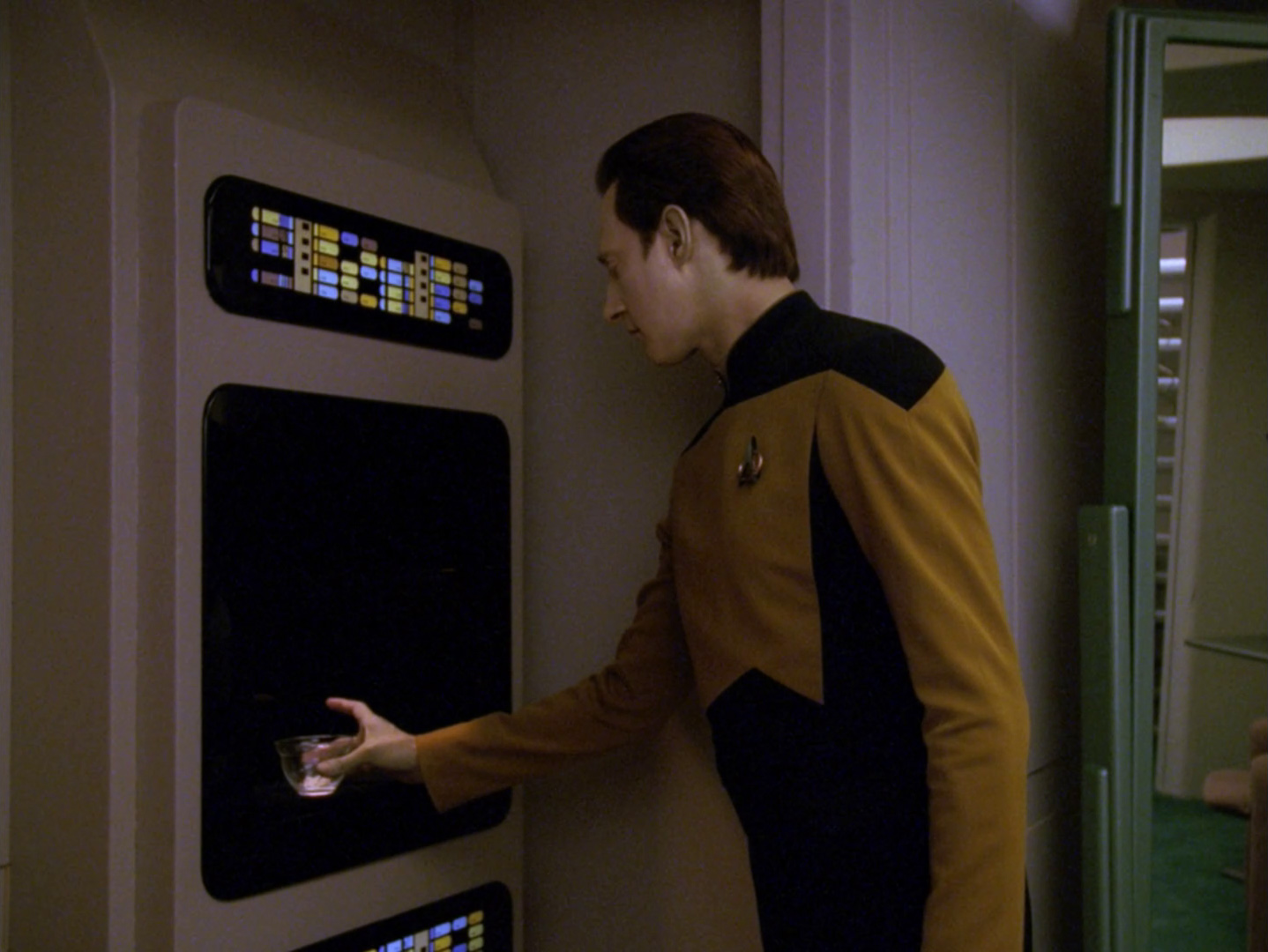
Commander Data prompts the Replicator to make a bowl of water for his cat, Spot. I didn’t have to look up the cat’s name which makes me a total nerd, I guess. (© CBS Studios Inc. / Paramount Pictures, still image from Trek Core)
Today’s declared cutting-edge tech (generative AI) and imagined 24th century tech (Replicators) differ in many ways. Notably, you must pay to use the most capable LLMs, since they still exist in a capitalistic society. And unlike a Replicator, which reliably materializes exactly what you ask for, language models are stochastic machines. They only ever produce probable results, never deterministic ones.
But there are interesting similarities as well. Generative AI can be viewed as an intermediate evolutionary step toward a Replicator. It can’t pour you a cup of hot English tea, but it can spill out lukewarm words and images. Though it cannot produce physical objects directly, you can let it output files for a 3D printer. You can also instruct modern LLMs with spoken language. You could build your own wonky, home-brewed Replicator today.
These days, AI is frequently claimed to make human crafts like writing, coding, and design appear redundant. It produces good-enough output that your boss may consider replacing you with a chatbot. If that technology is already deeply affecting our present, what would highly capable machines like Replicators mean for a future society?
Can we get a hint from science fiction? Did craftsmanship (also fine art, literature, music, …) disappear from Star Trek’s universe because everything could easily be replicated?
I did the superficial research you would expect for a silly blog post like this. And got some superficial answers.
First, we must realize that production needs and plot mechanics inform Star Trek’s world-building. Transporters save running time and VFX costs by eliminating shuttle flight sequences. Replicators explain how a ship remains self-sufficient for endless space travel. After all it’s still just a fiction of the future, produced within the mundane constraints of our present time.
However, the show portraits humanity as it has overcome material needs, with the Replicator among the key technological advancements that led there. When everything can be produced from pure energy — and given its limitless supply — there is no need to accumulate goods, and money as a currency for exchange becomes useless. Liberated from material concerns, humans in this future find meaning in the pursuit of knowledge, self-development, and philosophical exchange:
People are no longer obsessed with the accumulation of things. We’ve eliminated hunger, want, the need for possessions. We’ve grown out of our infancy. […] The challenge, […] is to improve yourself. To enrich yourself.
Interestingly, Star Trek has no equivalent technology to generative AI, to explicitly synthesize creative work.
Instead, many of its characters pursue crafts and arts themselves. Commander Riker cooks from real ingredients; he also plays the trombone. Commander Data paints, so does Captain Picard. Dr. Crusher writes plays and leads a theatre group, Captain Sisko’s son Jake writes a whole novel. We can spot several paintings and sculptures in the private quarters across all different shows, and although it is not always clear whether they are handmade, it is often implied.
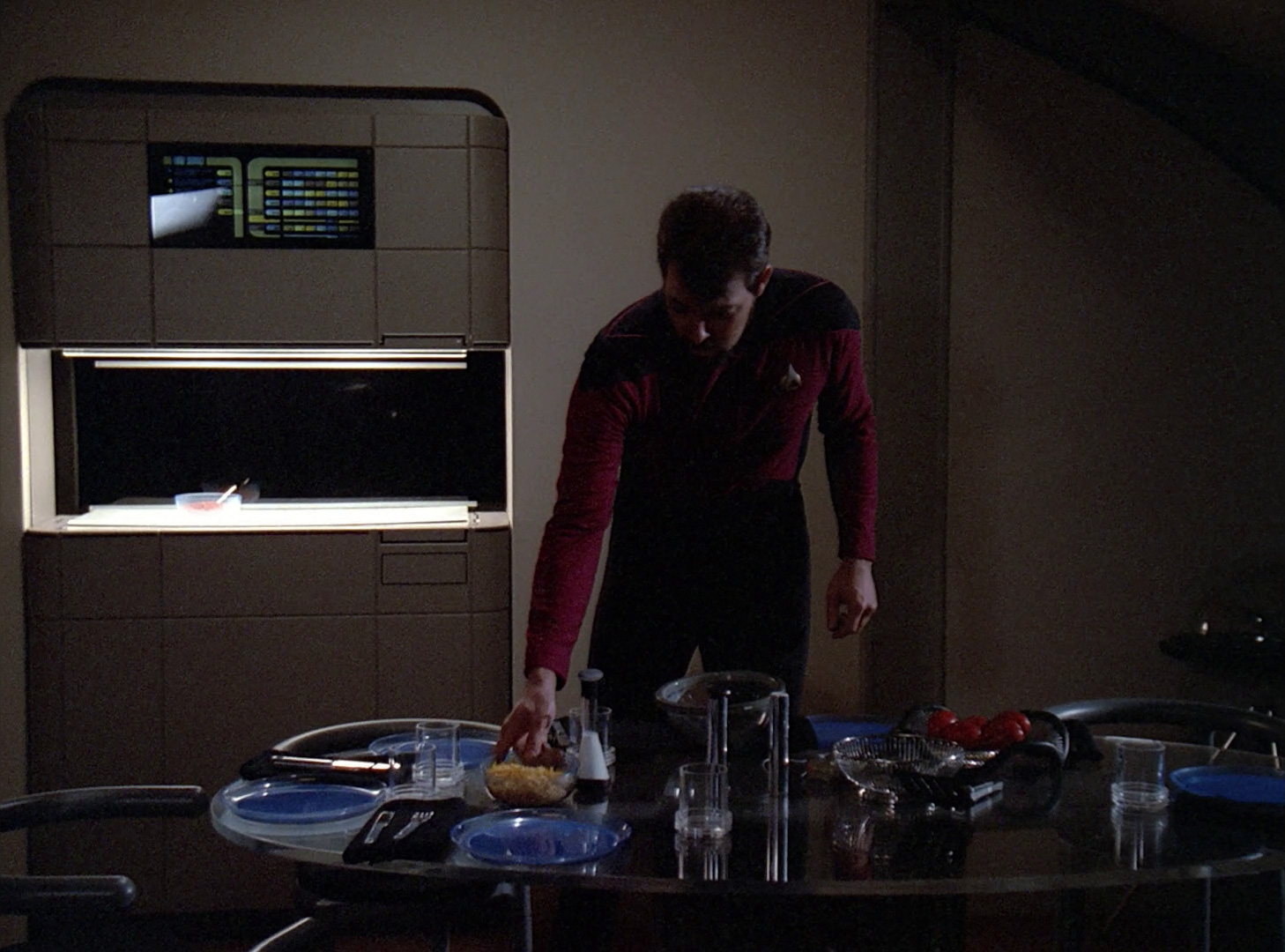
Commander Riker manually prepares “Owon” eggs he got at some star base instead of replicating a whole meal — which would “take away the flair”. He cooks a terrible gooey omelet. Only Worf, the Klingon, finds it “delicious!” (© CBS Studios Inc. / Paramount Pictures, still image from Trek Core)
While Replicators could produce or reproduce anything with molecular precision, they do not seem to be able to replicate the significance of handmade artifacts, which extends beyond their material value. Instead, such objects often become plot devices in Star Trek, carrying special meaning or expressing a character’s intentions. In one particularly wild episode of Deep Space Nine, Captain Sisko even builds an ancient wooden Bajoran lightship — entirely by hand, from authentic materials, and deliberately without the use of an industrial Replicator.
Craftsmanship and art did not disappear in Star Trek’s world. Instead, the show puts emphasis on how humans define themselves primarily through artistic and intellectual endevour rather than the super advanced, yet perfectly sterile, technology around them. When I think of this, no character ever seems particularly excited about Starfleet technology. It is just there to serve its purpose.
But that’s fiction. Depending on where you stand, you could believe that a real postcapitalist, hyper-technological society would no longer produce sophisticated art or craft because it has no economic value. Or you could believe that humans thrive in perfect living conditions while still making meaningful experiences — which they choose to express through art and craft. What Star Trek explicitly didn’t envision (although its technology seems sufficiently capable) was the artificial synthesis of human creativity.
Science fiction can inspire us to think about the future but it doesn’t predict it. Our actions form the future. Or, more nicely put:
Science fiction does something a lot more interesting than predicting the future — sometimes, it inspires people to make a given future, and sometimes, it sparks people to action to prevent a given future.
When I think about how I hope we will live in three hundred years, I still long for the vision of a humanity that “has grown out of its infancy” as projected into my childhood bedroom. But the handful of men who form our present “tech elite” — while explicitly referencing utopias like Star Trek alongside dystopias like Neuromancer — have arrived at an ideology scholars have come to call reactionary futurism. They dismiss the underlying morals of those stories and loot them only for their aesthetics to dress up their truly unhinged beliefs . This informs the tools and systems they create, potentially leading us to a full-on nightmare of a future. Ironically, these men have all the means to make the world a better place — except empathy. I leave you this quote:
The fundamental weakness of Western civilization is empathy, the empathy exploit. They’re exploiting a bug in Western civilization, which is the empathy response.
However, nothing is inevitable just because it’s already here. Maybe if we become more critical of the technology currently forced upon us and oppose the politics embedded in it, we can work together toward a better future.
I know it contradicts my anti-authoritarian beliefs but secretly … I wish we had a kind and wise captain who would rise from their chair, straighten their uniform, and say: “Make it so!”