Please note: This piece contains minor spoilers for Train Dreams as it describes the movie’s closing act in detail.
An older man nails a pair of rugged leather boots to the massive trunk of a redwood tree. He only uses a single nail. With him are a handful of other men, dressed in their modest workwear, as they surround three freshly dug, unadorned graves. Were it not for the three flimsy wooden crosses, God might seem absent from this bare-bones ceremony. No priest is present either; the old man speaks an essential eulogy: “Now they won’t just pass out of this world without nothing to show they was here.” But it’s time to return to work. Another man interrupts: “I wish I could let us all lay off a day, but it’s the company. The war don’t stop needing spruce just on account of a bad day for us.”
Train Dreams is a remarkable film, brutal and utterly tender in equal doses. We see those boots again in several brief shots throughout the story, partly sunken into the bark, as the tree has grown over many years. I feel like this movie left a similar lasting impression on me.
The story is all about Robert, a man born around 1886. As a seven-year-old orphan, he gets put on a train to Idaho, where he drops out of school some years later, wanders around and finds work as a logger, cutting trees and building wooden bridges for the Great Northern Railway.
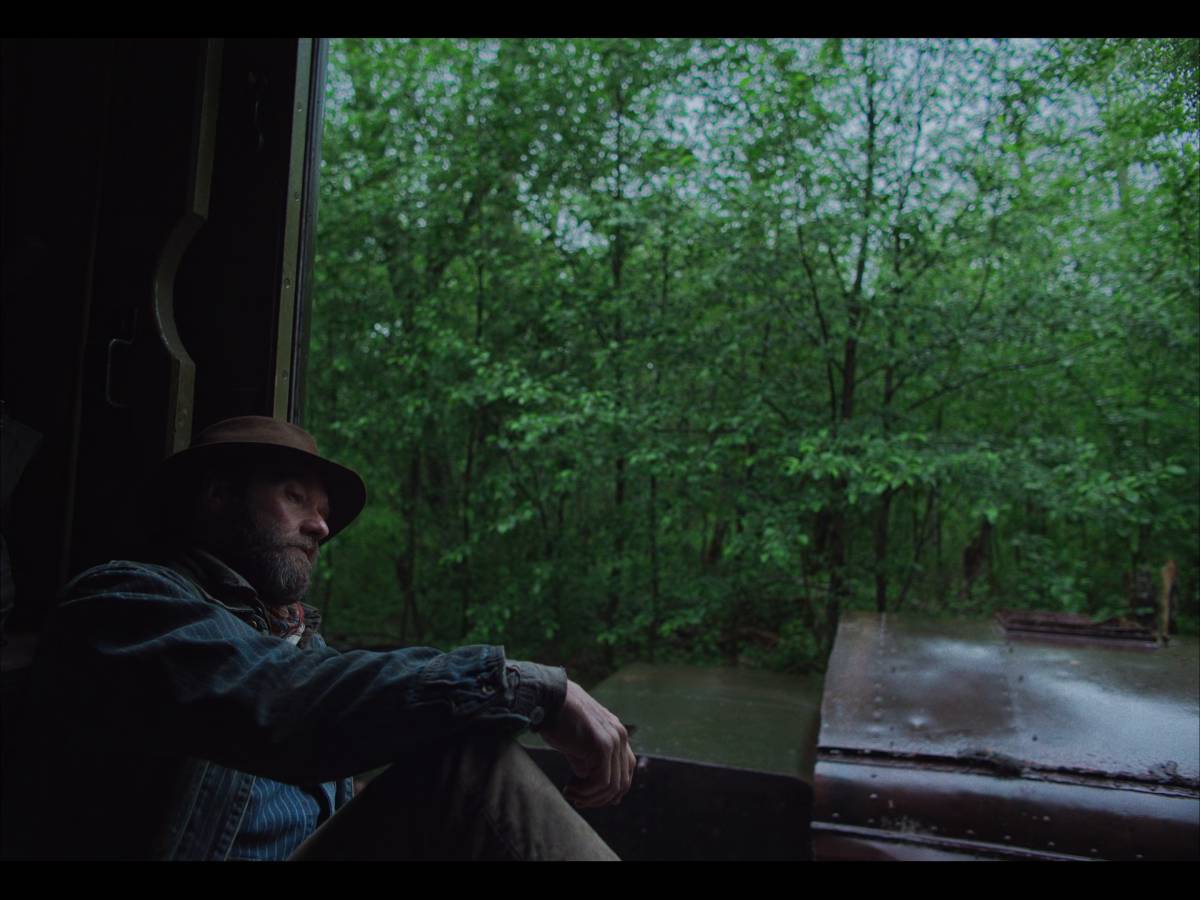
Robert Grainier, the protagonist of Train Dreams, on his way to a new job in the vast forests of the Pacific Northwest. (Image © Black Bear Pictures )
While we follow Robert’s life of 80 years, the most recurring element is contrast. We watch him experience dire loneliness and the warmth of a family. Traveling to faraway jobs and building a home by the river. Going through existential grief and simple joy. Through all this, he is depicted as a gentle and modest man who is even haunted by guilt for a murder he witnessed but couldn’t have prevented. Three women define the key moments in his life. All of them through acts of courage, confidence and wits — “devoid of the timidity normally associated with [their] sex.”
There is much more to unpack but I want to focus on what I see at the core of the movie: the contrast of nature and technology — how life and the environment change within a single lifespan through the dramatic impact of advancing technology.
The first machine we encounter in the movie is the locomotive. It demands men like Robert to cut its way through the forests, but it also extends their reach, transports goods for construction, and enables expansion across the vast country. It’s the story’s driving technology.
The lumbermen work with simple manual tools: axes and two-man saws. In one scene, we see them ponder the impact of their work around a fireside:
There’s enough logs for us to cut for 1,000 years. And then when the last one’s cut, well, first one will be growed up as big as anything around today.
Although Arn, the oldest of the group, already raises his concerns, at this point we still imagine nature and humanity in relatively healthy balance. What got chopped off will grow back, no need to worry. After all, the work pays well.
When Robert returns home, he realizes a sawmill could allow him to work while staying with his newfound family. He would still work as a logger, but the machine would enable him to sell his own product from where he lives, instead of traveling far for contracting work.
During his final job, he is exposed to the change of his work through the appearance of newly available tools. Now a single man with a chainsaw can do in minutes what took several men hours before. Robert seems alienated by this rapid change, perhaps beginning to sense the tipping balance between humans and nature. We see him repeatedly pulling the ripcord, having trouble starting his modern, motorized tool.
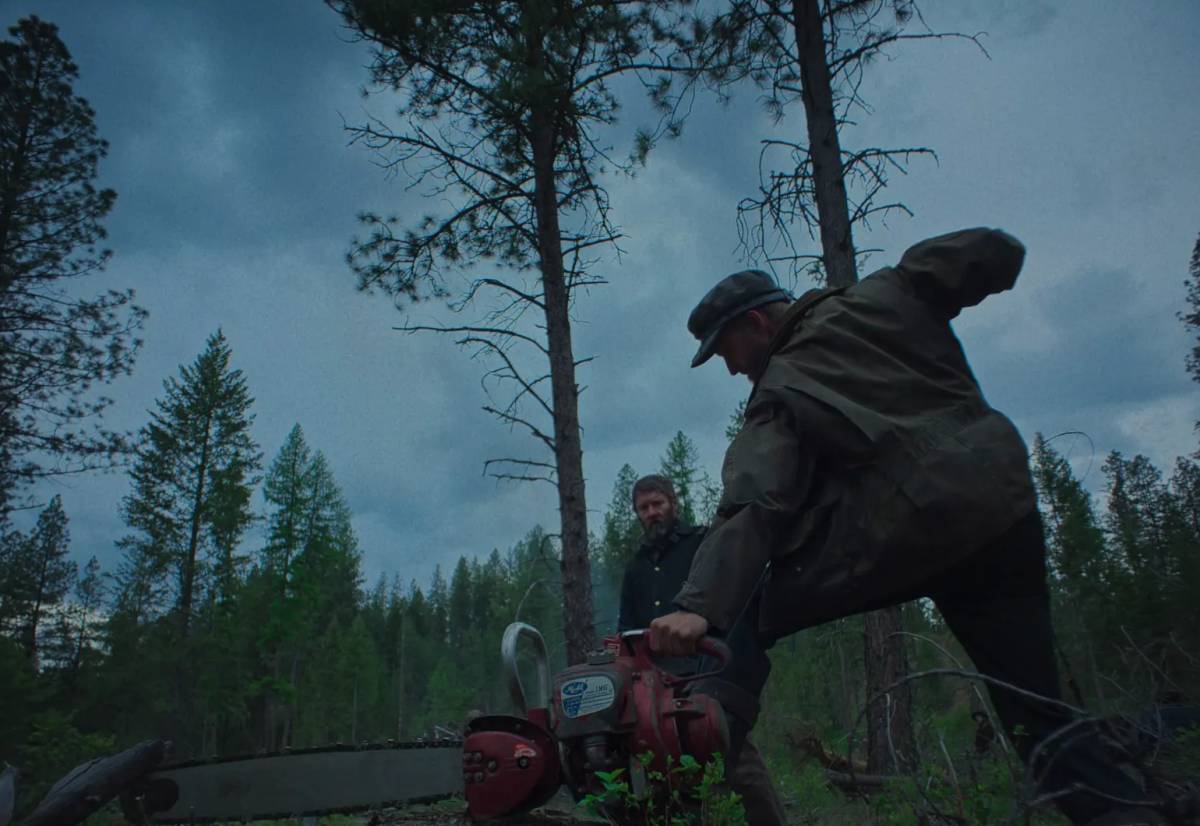
Robert (in the background), probably thinking to himself: “it’s a little different now out here.” (Image © Black Bear Pictures )
Robert is in his seventies when he takes a train, passing over steel and concrete bridges next to motorways, to a larger city. He sees a television screen through a storefront window, maybe for the first time in his life. It shows a transmission from the space capsule of the 1962 Mercury mission, America’s first orbital travel (several months after the Soviets claimed this record for all mankind). He wanders around town and ends up at a small sightseeing flight service: “Just four dollars, see the world as only the birds do.” A young woman pilot takes him for a flight in an open-cockpit plane — again, probably his first. He sees his life pass by before his eyes as the machine loops through the sunny sky. The experience fills him with joy and, finally, peace.
The movie ends with interior shots of Robert’s wooden cabin, his primitive home for most of his life. The sunlight spills through cracks in the roof and the weathered windows. Plants and moss are sprawling through the walls, floors, and ceilings. Flowers are growing from his deathbed. The narrator closes:
When Robert Grainier died in his sleep sometime in November of 1968, his life ended as quietly as it had begun. He’d never purchased a firearm or spoken into a telephone. He had no idea who his parents might have been, and he left no heirs behind him. But on that spring day, as he misplaced all sense of up and down, he felt, at last, connected to it all.
Train Dreams is a poetic lesson in humility toward nothing less than the world itself. We witness how within a single generation technological advancement exploded, changing almost every aspect of life, as an elderly Robert wanders the modern city of Spokane like a confused time traveler stranded in a distant future.
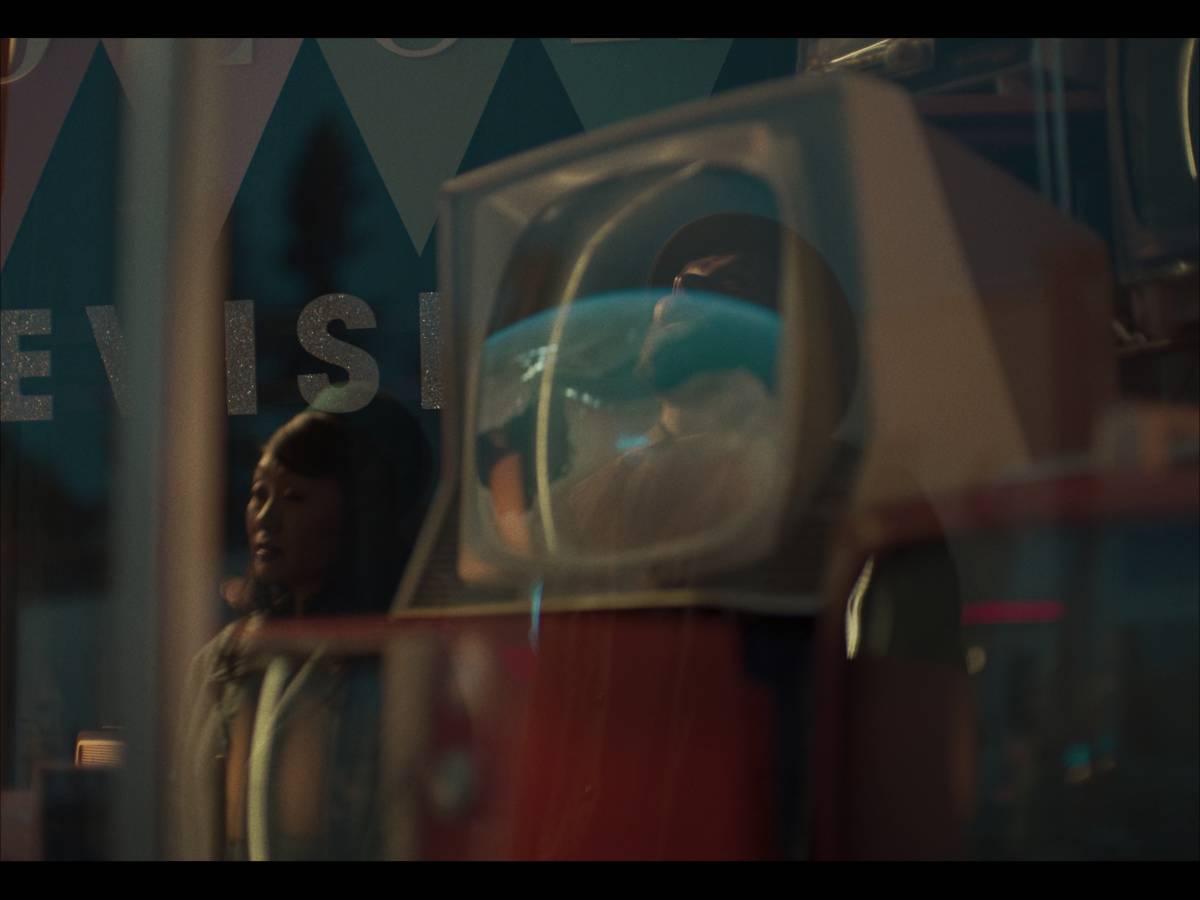
Robert just learned about the Mercury mission. “That’s us,” the woman next to him explains. (Image © Black Bear Pictures )
Not explicitly shown, but implied as a consequence of this progress, is our destructive impact on this planet. While exploiting nature for its resources, we spoiled the soil and oceans, poisoned the atmosphere, and pushed the climate toward collapse. What would have been impossible with the mere power of our muscles, we accomplished with technology. Now, the balance is gone.
This shift started with the Industrial Revolution which increasingly defined innovation and advancement predominantly in the context of technology. A climax of this view could be seen in Futurism . “Hurrah for motors! Hurrah for speed!” as Marinetti, the founder of the radical art movement, once proclaimed. In his belligerent 1909 manifesto he praised war as “the world’s only hygiene,” glorified patriotism, uttered his hatred for feminism and “morality,” expressed the desire to demolish all museums and libraries, and finally fetishized enormous factories and machinery — weirdly enthralled by the smoke they emit. Marinetti’s spirit still inhabits the pamphlets of today’s fast-movers and breakers of things, the Techno-Optimists and Effective Accelerationists. Technology as panacea, elevated to the status of a quasi-religion, while regulation and criticism are ridiculed.
Train Dreams, despite the machine in its title, is a much calmer piece of art which reads almost like a Futurist Manifesto in reverse — one in which nature is praised for its delicate balance. It portrays the world as endlessly inspiring, yet forever beyond our full understanding, hinting at how it existed long before our brief time in it, and how it will forever endure us. Or as Claire, another character in the movie, puts it:
In the forest, every least thing’s important. It’s all threaded together, so you can’t tell where one thing ends and another begins if you really look at it. The little insects you can’t even see, they play a role as vital as the river. The dead tree is as important as the living one. There must be something for us to learn from that.
There must be something to learn, indeed. I hope we will. I’d love to dream on for a bit.
Because this world is beautiful. All of it.